

96% of CFOs Are Already Using AI. So Why Are So Many Finance Teams Still Stuck?

Updated: Aug 12
IDC surveyed more than 1,200 organizations worldwide on AI in finance. The gap between intent and impact is where the competitive separation is happening.
The question that defined finance technology conversations two years ago - ״should we be investing in AI?״ - has been settled.
IDC's answer, from a survey of more than 1,200 organizations worldwide: 96% of CFOs are already using or piloting AI in their finance departments. The adoption debate is over.
What hasn't been settled is the more consequential question: are those AI investments actually changing how finance operates? Or are they proof-of-concept projects that demonstrated promise and then stalled?
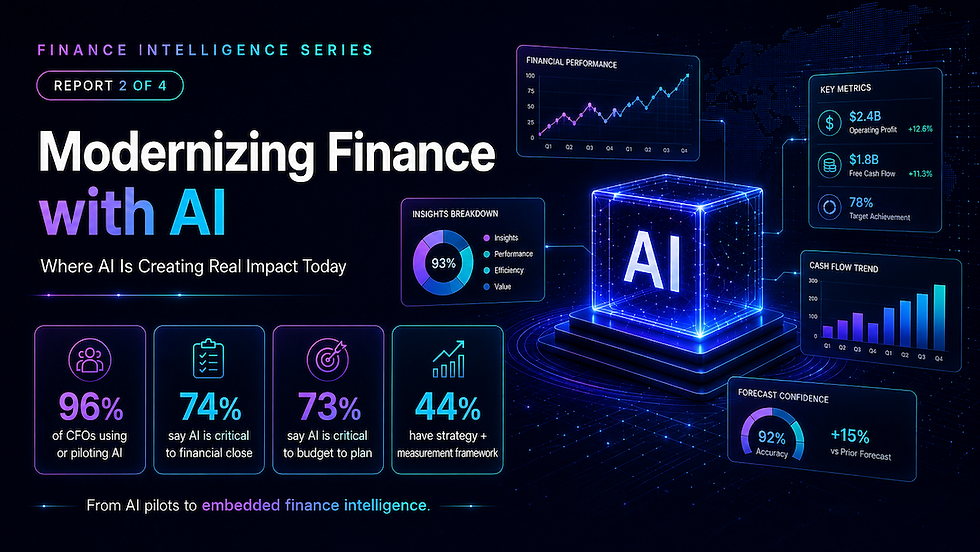
IDC's InfoBrief, Modernizing Finance with AI, is one of the most rigorous looks at that question we've seen. It doesn't just measure adoption, it maps where AI is embedded in real finance workflows, what business impact it's generating, and where the gap between strategic intent and operational reality is widest.
The findings are worth sitting with.
Finance Leaders Know AI Matters. Fewer Have Built the Foundation to Capture the Value.
IDC asked finance and accounting leaders how important AI is to their core processes. The responses were unambiguous. Financial close: 74% rate AI as critical or very important. Budget to plan: 73%. Balance sheet management: 73%. Working capital, procure to pay, book to bill, plan to perform: all above 70%.
These aren't peripheral workflows. They are the core of what the finance function does.
And yet when IDC asked those same organizations about their AI strategy, the picture became more complicated. Only 44% have a strategy that is both linked to business objectives and includes a measurement framework to evaluate success. A further 20% have a strategy linked to objectives but no way to measure whether it's working. Another 20% have a strategy that isn't connected to ERP business objectives at all. And 15% have no AI strategy.
That means the majority of finance organizations are either flying blind on their AI investments, or not making them at all in any structured way.
That gap between recognizing AI's importance and building the infrastructure to deliver on it is where competitive separation is happening right now.
What AI Actually Does in Finance: Six Use Cases
The most practically useful section of IDC's research is its detailed mapping of GenAI use cases across core finance processes. Not at the level of "AI can improve forecasting", but at the level of what the technology does, what changes in the process, and which business metrics improve.
Cash flow forecasting:
GenAI analyzes historical financial data, market trends, and external factors to generate more accurate, granular cash flow forecasts. It captures patterns that traditional models miss , including anomalies that signal potential disruption before they materialize. The metrics that improve: forecast accuracy and time to determine daily cash balance.
Predictive liquidity planning
GenAI analyzes supplier data to identify patterns and trends, enabling treasurers to make better-informed liquidity decisions based on predictive insight rather than historical averages. The metrics that improve: working capital, debt-to-cash ratio, and cash balance.
Accounts payable
Working alongside OCR and machine learning, GenAI extracts data from invoices, purchase orders, and receipts and summarizes the supplier emails that flood AP inboxes so that teams spend less time on data entry and more time on value-added work. The metrics that improve: invoices processed per FTE, average cost per invoice, and days payable outstanding.
Accounts receivable.
GenAI combines structured payment history data with unstructured market and economic data to make faster, more accurate credit decisions. It handles billing inquiries and dispute communications, reducing the burden on customer service teams while building customer loyalty. The metrics that improve: billing dispute resolution time, bad debt risk, and days sales outstanding.
Corporate tax and audit
GenAI provides a real-time regulatory assistant that summarizes complex tax and compliance changes as they happen and monitors contracts, leases, and tax filings for anomalies that indicate compliance risk. The metrics that improve: compliance cost per incident, number of violations, and recognition and resolution time.
Financial close
AI-powered ERP changes the close process fundamentally: processes become constrained with prescriptive recommendations, data is brought forward into the process rather than extracted after the fact, and governance frameworks are built into workflows rather than layered on top. More than 30% of finance organizations report that their AI-powered ERP already provides more actionable insights, ties processes to governance, and allows system-driven actions based on preconfigured approvals.
The Shift That's Already Underway
IDC's research includes a forward-looking question: what business process changes do organizations expect from GenAI-powered applications in the next 18 months?
The top answers: generate future possibilities and outcomes (16%), generate more actionable business insights (14%), generate more actionable customer insights (14%), reduce manual business process steps (13%), and accelerate process cycle times (12%).
Taken together, these responses describe a finance function that has moved from reporting on the past to actively shaping the future — surfacing what's happening now, modeling what comes next, and giving finance leaders the intelligence to act in the moment rather than after the fact.
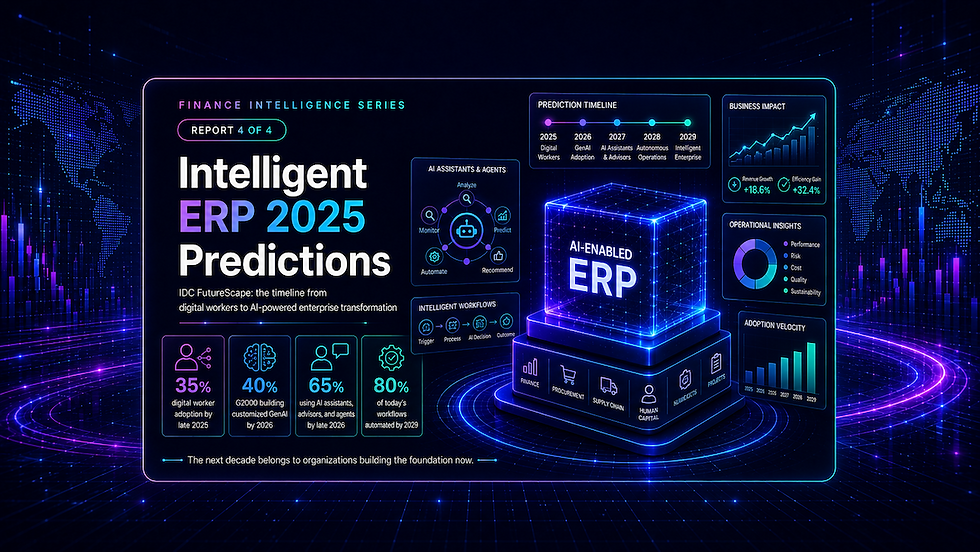
IDC frames this as the shift from systems of record to systems of intelligent planning. It is not a distant vision. According to IDC's FutureScape predictions, by mid-2025, 50% of end users will leverage AI-infused applications operating in this mode. For organizations still on legacy systems, IDC's assessment is direct: modernize immediately or risk being surpassed by a digital world already moving faster.
What This Means for Finance Teams in SAP Environments
For organizations running SAP or evaluating the move to SAP S/4HANA Cloud the IDC research maps directly to what's possible with SAP Business Suite and the capabilities it brings to finance.
The use cases IDC documents are not theoretical. They are live capabilities available today: AI-driven close processes, embedded GenAI for AP and AR, predictive cash management, real-time compliance monitoring. The question isn't whether the technology exists. It's whether your data foundation, process design, and implementation approach are set up to deliver the outcomes IDC describes.
That's the work Qubittron does with our clients every day. Not getting the system implemented, but building the foundation that makes the intelligence possible.
The full IDC InfoBrief is available to download below.


Comments