

The Real Reason Finance Leaders Can't Move Fast Enough And What IDC Says to Do About It

Updated: Aug 17
IDC's July 2025 Analyst Brief on AI-Powered Business Suite for Finance identifies the structural problem holding finance teams back, and what the path forward actually looks like.
Here's a moment most finance leaders know well.
A disruption hits a tariff announcement, a supply chain failure, a sudden shift in customer demand. The C-suite needs answers. What's the liquidity exposure? What does this do to our margin? Which markets are most at risk and how fast can we pivot?
And the finance team goes to work. Running reports. Extracting data. Reconciling numbers from systems that weren't designed to talk to each other. By the time the analysis is ready, the window for the optimal decision has often already closed.
This is not a story about people failing at their jobs. It's a story about tools built for a different era, still being asked to support decisions that require real-time intelligence.

IDC's July 2025 Analyst Brief is the most direct and current piece of research we've seen on this problem. Written by Simon Ellis, Group Vice President of Global Supply Chain, and Mickey North Rizza, Group Vice President of Enterprise Software, it doesn't describe a future state. It diagnoses the present and makes a clear case for what needs to change.
The Problem Is Infrastructure, Not Ambition
IDC is careful to distinguish between the desire to operate with financial intelligence and the ability to do so. Most finance leaders understand what they need. Many are actively investing in technology to get there. The gap is in the foundation underneath.
A significant percentage of finance professionals tell IDC they don't have the tools to navigate a dynamic, quickly changing environment. The reasons are consistent across organizations: they lack a common data repository, their systems don't integrate well with each other, or they operate hybrid IT environments that introduce latency precisely when speed matters most.
The consequences are real and concrete. As IDC documents, the information and data lag reduces finance's ability to respond to situations accurately within the timelines that disruptions demand. Without the right systems, the ability to pivot quickly is nearly impossible.
One finance leader at an industrial goods manufacturer put it plainly in conversation with IDC researchers: "Data and analytics challenges are preventing us from making financial trade-offs quickly. Too often, we must rely on instinct and gut feel to make highly impactful working capital decisions. When we get it wrong, the business suffers. We need better and more current data and intelligent insights at our fingertips."
That quote captures something important. The problem isn't that finance teams lack intelligence or effort. It's that the systems they're working with weren't built for the speed and complexity the business now requires.
Why the External Environment Makes This Urgent
IDC frames the infrastructure problem in the context of the macroeconomic environment finance leaders are operating in - and framing matters.
Geopolitical tensions, persistent inflation, supply chain vulnerabilities, evolving trade policies and tariff risk: these forces are creating an operating environment that demands proactive, scenario-based financial decision-making. The traditional tools of forecasting and risk management are being stretched beyond what they were designed for.
In this environment, the CFO's primary challenge isn't just managing competition in the traditional sense. It's managing pervasive market uncertainty, retaliatory trade measures, and cascading disruptions across interconnected supply chains. That uncertainty complicates forecasting, investment decisions, and financial planning in ways that require more than incremental improvements to existing systems.
What it requires, IDC argues, is a fundamental rethink of the financial technology foundation.
The Case for an Integrated Suite
IDC's prescription centers on three elements that need to work together and not separately, not through point integrations, but as a unified platform.
Comprehensive, integrated data Speed to decision is critical, but transformation is consistently slowed by functional and process silos and disconnected systems. The ability to align and integrate data, both in terms of volume and quality, is the prerequisite for everything else. Without it, AI has nothing useful to work with.
Applications that are aligned and integrated IDC has observed that technology vendors often struggle to articulate clearly how AI conveys competitive advantage. The answer, IDC argues, is that best-in-class financial applications integrated into a single suite with market-leading capabilities allow organizations to make decisions faster and with data-driven insight rather than instinct. Fragmented application portfolios undermine this at every layer.
AI built in, not bolted on
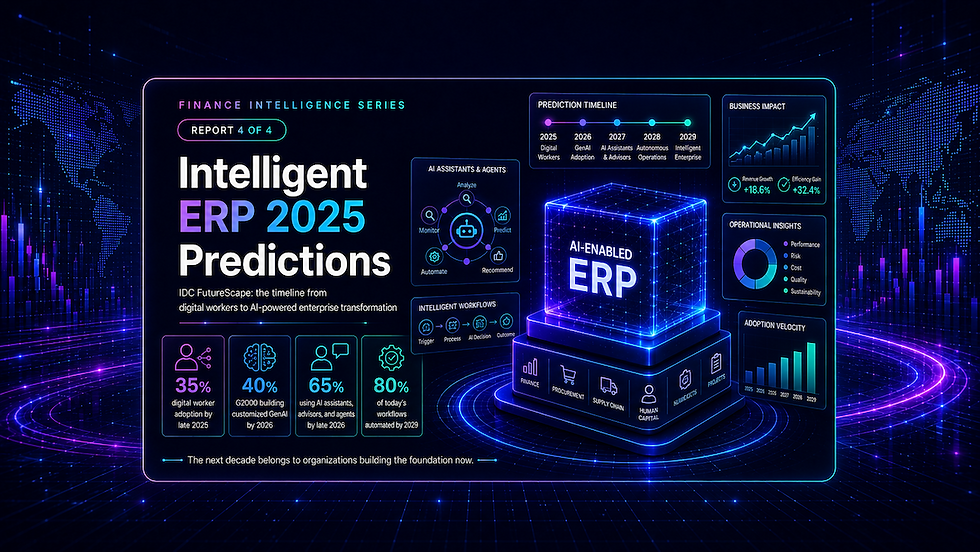
Over the next three to four years, IDC expects generative AI and agentic AI to transform financial applications to the point where agent-driven capabilities are standard, not exceptional. This transition, IDC is explicit, is significantly more achievable with an integrated suite. Organizations attempting it across fragmented architectures will find the journey far slower and more costly.
On agentic AI specifically, IDC's data is striking: 62% of finance professionals are particularly interested in using agentic AI for financial reporting, and 58% for budgeting and forecasting. Their stated goal is having these capabilities as part of an integrated platform and not as standalone additions to existing tools. The vision is a coordinated network of specialized AI agents, each communicating and learning in real time. A shift in demand triggers the supply chain planning agent to reallocate resources, the finance agent to update projections, the workforce agent to adjust staffing — simultaneously, enabled by unified data and integrated applications.
What AI Has Already Delivered
IDC's research isn't speculative. In its 2024 CFO Survey, 81% of respondents who had implemented or piloted AI in their finance function said it had a positive impact. Only the remainder felt it was too early to tell. None said it was negative.
The reasons for that positive impact are structural. Finance resources have been shrinking for years while the volume of work asked of the CFO's office has grown. Traditional AI, GenAI for contract management and ad hoc reporting, agentic AI for productivity — has absorbed workload that would otherwise have required headcount.
The result is a finance function that can do more with what it has. And as AI capabilities continue to mature, that multiplier effect compounds.
IDC's Conclusion
IDC's closing argument in the brief is worth quoting directly because it captures the urgency with unusual clarity for research of this kind:
"As disruption continues to plague companies across all industries, operating with older, poorly integrated financial management tools increasingly drives uncompetitive business performance. In an environment where finance decisions need to be made efficiently and quickly, IT system drag is simply no longer tolerable."
It goes on: "Modern applications, leveraging data and rapidly evolving AI tools within a single platform, are increasingly best practice. IDC would recommend that companies across all industries, and of all sizes and scale, explore these platforms to see what they can do for their financial management capabilities — and the business."
What This Means for Organizations Running SAP
For organizations in the SAP ecosystem or evaluating the move to SAP S/4HANA and the SAP Business Suite the IDC brief maps directly to what's available today. The integrated suite IDC describes, combining comprehensive data, aligned applications, and embedded AI, is the architecture SAP Business Suite is built on.
The SAP Business Data Cloud harmonizes data into action-ready insights. SAP Business AI with Joule as the AI agent orchestrator uses those insights to automate operations, streamline collaboration, and accelerate decisions. The Business Technology Platform ties it together into a continuous cycle of value.
The gap between what IDC describes as best practice and what SAP makes possible has closed. What remains is the implementation and adoption work — building the foundation that makes the intelligence operational rather than theoretical.
That is the work we at Qubittron do.
We help enterprises move from having SAP implemented to having it work the way IDC describes: with the data integrated, the processes redesigned for AI, and the outcomes that justify the investment actually realized.
The full IDC Analyst Brief is available to download below.


Comments